How do coin counters & sorters work, and are they accurate?
Autumn Deals! Use the code AUTUMN10 to get 10% off!
 468 Google reviews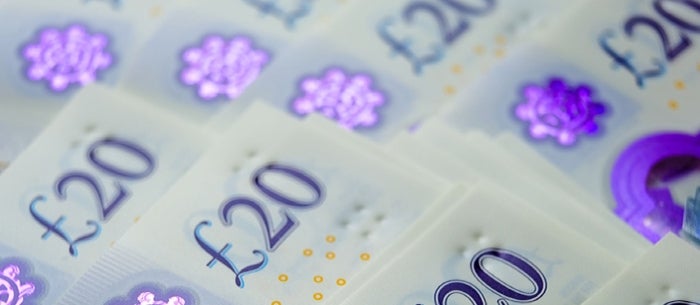
UV detection is one of the most common methods used to verify the authenticity of items such as banknotes and official documents. The results are quick, clear, and easy to see. But the science behind it is less commonly known. In this blog, we explain more about how UV light works, and how it can help protect your business against counterfeits and fraud.
When we think about UV, we often connect it to the sun. But did you know that there is a difference between the invisible radiation emitted by the sun, and the visible light that we use for detection?
UV radiation consists of light particles that have a wavelength between 100 and 400 nanometres. These particles cannot be seen with the (naked) eye as we naturally filter it out. The most common source of UV radiation is the sun.
UV light that is emitted by lamps is still within the same wavelength spectrum (300 to 400 nanometres), but is visible. This is because our eyes register the converted light from these lamps, and not the pure ultraviolet itself.
Many different elements and materials react to UV light. It can harden glue and paint (such as nail polish), and it can illuminate any invisible substance that contains fluorescence. This includes blood, laundry detergent, and security elements embedded in banknotes and other official documents.
Banknotes and official documents often contain hidden security features that become visible underneath UV light. These features are carefully designed and placed, making them very hard to copy. This is why UV detection is such a reliable way to identify counterfeits.
Tip! If you want to know where the UV features are located in banknotes, simply consult our verification guide.
As fluorescent materials (such as UV ink) are invisible, you don't always realise how often it is used and how it protects us against counterfeits and fraud every day.
Banknotes: Central banks use UV features (like symbols and patterns) to make it more difficult to replicate money.
Credit cards: Credit card companies embed physical cards with special UV markings to verify their authenticity.
Identification documents: Documents such as passports, driving licences, and ID cards contain similar markings.
Event tickets, wristbands, and stamps: Event organisers use UV reactive ink to verify the validity of entry tickets.
Brand packaging: Manufacturers use UV reactive ink on their labels and packages to mark them as original.
Logistics and warehouses: Invisible UV markings can also be used for internal tracking and control.
It's very simple. UV detectors are essentially just lamps that emit an ultraviolet light of around 315 to 400 nanometres. Enough to illuminate all the hidden elements and markings described above.
UV detectors are a popular choice amongst businesses because they are:
Accurate: Every element lights up.
Fast: The results are immediately visible.
Easy to use: Anybody can use them without much training.
Non-invasive: Documents remain undamaged.
Versatile: Suitable for banknotes, identification documents, credit cards, and more.
Some UV detectors also include white light detection. While UV light shows fluorescent security features, white light helps reveal details inside the paper or document itself.
White light can make watermarks (such as portraits or numbers) visible, as well as microprints with very small text and security threads embedded in the paper.
By combining UV detection and white light detection, you can check multiple security features at once. This provides extra confidence when verifying banknotes and documents.
Safescan offers a wide range of reliable counterfeit detectors that help protect your business - at all times. All you have to do is choose the one that best fits your needs.
Looking for a stationary detector? Check out the Safescan 55 LED and Safescan 75 LED. These detectors offer powerful light to verify your banknotes and documents. The Safescan 75 LED even offers white light detection for extra security.
Taking your business on the road? No problem! Simply connect them to a powerbank, or checkout our portable UV detectors: the Safescan 35 or Safescan 40H.
No matter what option you choose, Safescan detectors always provide reliable counterfeit detection. Helping protect your business against counterfeits and fraud.